
Vogelmann to Fogleman
Our family name has not always looked the same throughout history. Like many if not most names ours has evolved as well to better fit the language and sound's of new lands and settlements. Surnames were given for the purpose of more specific identification of families. There are four primary sources for second surnames which are: occupation, location, father's name and personal characteristics. The Fogleman surname appears to be due to location in origin, and is believed to be associated with the Germans and Dutch, meaning "one who came from, or lived near the sign of the bird." There were a few variations of spelling of Fogleman here are a few: Fogle, Fogleman and Foglemans.
The Fogleman family also has a documented family crest. The source can be found in the Rietstap Armorial General. Herald artists of old created their own unique designs and motto to represent ones own family. The Fogleman's however didn't have a known motto. The description was originally written in another language so the following is a translation of the description of the Fogleman coat of arms.
"Divided black over gold, one monster over the division, the top portion a heraldic gold eagle the bottom, a man of black."
Above the shield and helmet is the crest which is described as:
"One young man issuing clothed in black crowned gold, with wings instead arms."

Some time ago...
Hans Adam and Ursula
Hans Georg & Anna Margaretha
Hans Georg/Jerg was born to Adam and Ursula Vogelmann on the 13th of November 1699 in Sanzenbach, Germany. He married Anna Margaretha Sanwald in 1724 in Raibach. She was the daughter of Hans Sanwald and Catherinae Koppenhoffer. Georg was the youngest of ten children, two of which had died by the time of his marriage. He god fathered a child in Sanzenbach on 29th January 1738. In 1739 the family moved to Tiergarten in the parish of Orendelsall. Georg and Anna Vogelmann also had ten children. Georg died on the 28th of December 1758 at 59 years of age. Anna died on the 5th of October 1757 at age 58. They were both buried in Tiergarten, likely in the old graveyard around the Orendelsall church.
Johann Georg &
Catherina Elizabetha
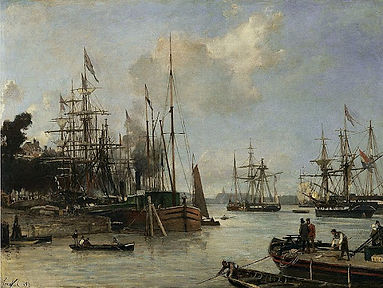
Port at Rotterdam, Netherlands
.jpg)
Great Wagon Road


Birth of a Church
After ten years settled as dispersed communities, rarely any seeing each other or the possibility to help one another, the Low's, Fogleman's and others beganan 18th century real estate development experiment in the Carolina wilderness called "Low's Town." David, George and a few others began a 3/4 acre town lot's in 1770. The concept was to create an experience like their native homeland in Europe. Farmer's lived together in villages and walked or rode to their fields in the surrounding parish every morning. The residents of this town hoped that this would help. George and Catherine had given birth to five more children after settling in. The couple would welcome the idea of this new development to bring the families closer together and make life somewhat easier. Unfortunately the development failed and never really came to life. It is likely that the farms were too far to make it a reality. There also could have been disagreements and tension within the group as well that hindered the project. Perhaps the town became a victim of the upheavals of rebellion, war and revolution, of which there were many in these parts.
After the town failed the Low's, Fogleman's and other new German families decided to build a church and make it the center of the community. Both Lutheran's and Calvinist's built a log structure which they shared. Like their counterparts in Pennsylvania and elsewhere in North Carolina in such "union" churches, they kept their worship services separate. A Moravian minister visiting the area in the 1770's wrote that the building seated two hundred people, and that he once wittnesed three hundred people crammed into it. The settlers on Stinking Quarters must of had an important role in the church and its development Moravian minister refereed to some by name. These names included David Low (Catherine Fogleman's older brother) Catherine herself and George Fogleman and other's that Low's Luthern Church was named after.After the War of the Revolution the Calvinist's of the church broke of and joined the so called "Brick Church" a few miles away.
Low's Church is one of the oldest churches in North Carolina. The Lutheran Church is located on the Old Trading Path which ran from Hillsborough to Salisbury. The original log structure is long gone but Low's Church has stood the test of time. The church still stands as a reminder of the faith and history of those whom came here from far away. The only remaining structure from the earliest days of Low’s is a “dry” (no mortar) stone wall. The wall encloses a portion of the Low’s cemetery, and the stones have been reset over the decades. The cemetery itself includes grave markers dating back to the early 1800’s (a few early ones in German) with unmarked burials from the previous century.

Hans Vogelmann (born ca. 1644) of Neunkirchen, Austria later Germany married Barbara Seitz (born ca.1636). Little is known about Hans and Barbara but what we do know at the present time is that he gave birth to a son Hans Adam Voglemann in 1644 in Neunkirchen. Hans Adam was baptized there on the 7th of April 1644. He married Ursula Wurtemberger (b.1656). Ursula lived in Sanzenbach at the time of her marriage to Hans Adam. He was living with his godparent Adam Heiner von Neunkirchen. Prior to their marriage the two were working as household servants at an inn located in nearby Bubenorbis, Baden-Wurttemburg. It is believed that a Michael Wurtemburger also served at the inn and was Ursula's Uncle. Shortly after their marriage Adam and Ursula moved to Sanzenbach. While there they acquired a lot of land and Adam became the village "Hauptmann" (Captain), meaning the highest official in Sanzenbach. During their life Adam and Ursula had 10 children and 38 grandchildren. Hans Adam died of a stroke in Sanzenbach on the 22nd of June 1724. Ursula lived another two years dying at the age of 70.
Johann George was the fifth child of Hans Georg and Anna Margaretha. He was born September 2, 1732 in Sanzenbach. Georg moved with his family to Tiergarten in 1739. In 1751 Georg and his brother Michael left his family there in Tiergarten to embark on their journey to the new world (America). Both Georg and his older brother Michael made it to York, Pennsylvania on the 5th of September 1751. Like most other men Georg was a farmer by trade and at some point became a linen weaver.
Georg finds love
While attending service at Sherman's Church there in York George met a girl by the name of Catherine Low. Catherine was 16 years old when she met Georg and he wasn't much older. Catherine was the daughter of Peter and Maria Elisabetha Low. They had immigrated from Lembach, France in the mid. 1740's via the Port at Rotterdam, Netherlands. Catherine was six years old when making the voyage with her parents and at least four other siblings. Georg and Catherine attended the Sheman's Church and sometime within the next two years married. The couple married younger than what was normal in Georg's and Catherine's birthplace in Europe.
Greener pastures
While living there something came up that would alter their future decisions. Militia units led by George Washington was set to deploy deep into French and Native territory to the Southwest of Pennsylvania. Washington had been surveying the area and his intentions were clear. He wanted the colonies or at least his colony to expand westward and take new lands. Tensions began to arise within villages in and around Pennsylvania. Soon war broke out and the French and Indian war had began. News of places being burned and war looming all around, local families were at unrest. These and possibly other events pressed the Low family to seek a home elsewhere. While still living there in York Georg and Catherine gave birth to their oldest son Peter Fogleman in about 1758. He was named after Catherine's father.
The time came when the Low's and other families decided it was time to leave. As early as 1759 families were moving southward into southern Virginia and the Carolina's. Catherine was now 21 years old and had lived in Pennsylvanmia since she was six. The Low's, Fogleman's and other families set out on the migration south. The trip southward was less treacherous but wasn't without difficulty. The group had two choices. They could go east or west of the Blue Ridge Mountains either way the trip was a 30 day journey. The Low's and Fogleman's chose to travel west of the Blue Ridge. The trip would be much easier at first but later a true challenge. During this journey the caravan faced many hardships. They risked drowning, wagon accidents, sickness and attacks from natives and bands of thugs wishing to pray on the women and loot the wagons. The mountainous region they had to cross over was the biggest challenge but one can only imagine the beauty they beheld of the triad region atop some of those peaks. It had to offer them some motivation during their hard journey over treacherous terrain.
When they reached a certain area they set up camp one last time while the men set out to find the land they would soon call home. Georg found a 208-acre plot of land along a creek known as Stinking Quarters Creek in what was then Orange County. He purchased the land from a Henry McCulloh and his associates in May of 1760. Here in 1760 Georg, Catherine and their toddler Peter would settle for the remainder of their life. As for Georg's brother he found land nearby as did Catherine's brother David and others in the group.